India's Environmental History—A Reader by Mahesh Rangarajan
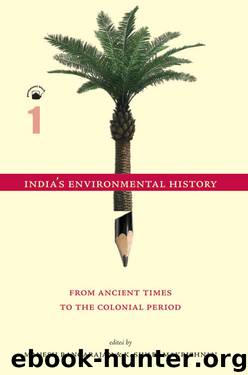
Author:Mahesh Rangarajan [Rangarajan, Mahesh]
Language: eng
Format: epub
ISBN: 9788178244396
Publisher: Permanent Black
Published: 2018-06-11T18:30:00+00:00
Natural Economy
Over the centuries, local territories of natural resource utilization diversified along a topographical continuum running from the highest highlands, where shifting jhum cultivation prevailed, to the lowest lowlands, where farmers grew boro rice, planted in December—January, when fields dry out enough to plant, and harvested before the floods arrived in May—July. In 1800, forest still covered much of the land, roughly in proportion to altitude. Permanent agriculture expanded and contracted, in fits and starts; and expansion only gained a firm upper hand in the nineteenth century.37 Farmers facing recurring flood calamities routinely abandoned old farm sites, allowing forest to return as they colonized new land. The 1780s brought the worst floods in memory, which destroyed farm investments in the years when the Tista river shifted its course, joined the Brahmaputra, and changed its course as well.38 The 1790s brought floods and earthquakes that demolished the lowest farmland behind the eighteenth-century market town of Ajmiriganj, spawning endemic malaria, which stymied new colonization till 1900.39
Nature’s topography defined economic geography. In the late eighteenth century, farming communities in the lowland floodplains grew almost nothing but boro rice, which they consumed with locally abundant fish. There were no large market centres, let alone major cities, by the standards of lower Bengal, no weavers exporting cloth, and no locally resident rich merchants, let alone portfolio-capitalists.40 Hundis were so hard to find that early Company Collectors had to ship revenues on armed boats to Dhaka.41 No European company ever made a major commercial investment in the Surma basin. Yet markets thrived, as supply and demand met in countless small transactions with little input from urban commercial networks.42 Rulers received tax only in cash. Specialists in fishing, horticulture, hunting, mining, trade, transportation, crafts, finance, and administration all bought rice in local lowland markets that thrived amidst the flood-induced uncertainty of local rice output. In 1790, Sylhet district had over 600 named marketplaces (haat, ganj, and bazaar).43 Long-distance commodity chains passed through them, up and down the Meghna, to and from Dhaka, Narayanganj, and Bakarganj (near Barisal), and up and down the Barak valley, to and from Manipur, Assam, and Burma.44 As the number of market centres increased in Bengal generally,45 Sylhet town became a more active regional market, to which the Manipur and Tripura rajas built a new jungle road from Manipur, in the 1790s.46
Many commodities in the lowlands carried Khasi social identities. Khasi merchants brought goods from Assam through mountain river ports at Pandua and Jaintia.47 Khasis sold mountain ‘jhum’ rice in Jaintia. In high valleys and on low slopes, Khasis grew areca nut, betel, turmeric, and fruits to sell in the plains, along with wax, ivory, and cloth. Mountain Khasis also specialized in iron mining and smelting, and they would denude whole forest tracts to stoke their blow-bag iron furnaces, with cowhide bellows, before moving on to exploit new fuel- wood sites. Khasi iron,48 steel, and metal tools travelled lowland rivers routes, along with their gold, silver, other metals, and ornaments.49 Khasi mountain quarries behind Sunamganj provided the finest quality limestone.
Download
This site does not store any files on its server. We only index and link to content provided by other sites. Please contact the content providers to delete copyright contents if any and email us, we'll remove relevant links or contents immediately.
| Anthropology | Archaeology |
| Philosophy | Politics & Government |
| Social Sciences | Sociology |
| Women's Studies |
The Secret History by Donna Tartt(19469)
The Social Justice Warrior Handbook by Lisa De Pasquale(12293)
Thirteen Reasons Why by Jay Asher(9118)
This Is How You Lose Her by Junot Diaz(7056)
Weapons of Math Destruction by Cathy O'Neil(6466)
Zero to One by Peter Thiel(5951)
Beartown by Fredrik Backman(5937)
The Myth of the Strong Leader by Archie Brown(5623)
The Fire Next Time by James Baldwin(5582)
How Democracies Die by Steven Levitsky & Daniel Ziblatt(5322)
Promise Me, Dad by Joe Biden(5229)
Stone's Rules by Roger Stone(5190)
A Higher Loyalty: Truth, Lies, and Leadership by James Comey(5087)
100 Deadly Skills by Clint Emerson(5023)
Rise and Kill First by Ronen Bergman(4890)
Secrecy World by Jake Bernstein(4878)
The David Icke Guide to the Global Conspiracy (and how to end it) by David Icke(4850)
The Doomsday Machine by Daniel Ellsberg(4619)
The Farm by Tom Rob Smith(4611)
